
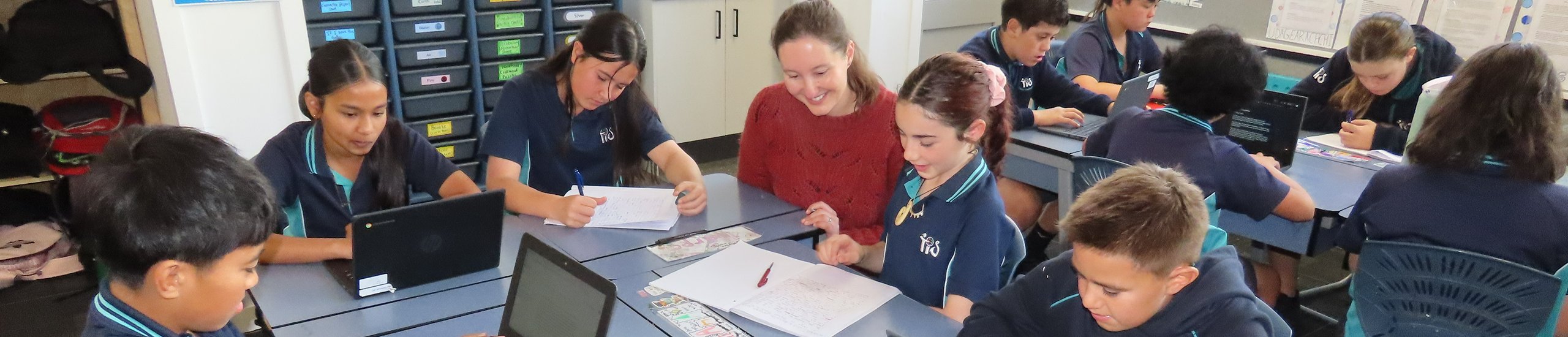
At intermediate level, maths learning is about helping students notice patterns, solve problems, explain their thinking, and use maths in everyday life. In the New Zealand Curriculum, Mathematics and Statistics focuses on relationships in quantities, space, and data, and helps students make sense of the world around them.
These are good options for extra practice at home, including free sites, plus Times Tables Rock Stars which our school pays students to access.
e-ako maths
This is an engaging online learning tool which is aligned to the New Zealand Maths curriculum. You can find it here. It can be useful when your child has school access. Your child can sign up with their school email address to access this online learning.
Khan Academy
Free video lessons and practice across number, algebra, geometry, statistics, and more. Access it here.
NRICH
Free rich tasks, puzzles, games, and problem-solving activities for students, parents, and teachers. It is especially good for children who enjoy being challenged. Have a look here.
Math Is Fun
A free site with explanations, games, puzzles, worksheets, and a maths dictionary written in student-friendly language. Explore it here and see why Math is Fun!
Times Tables Rock Stars
Our school pays for access to this highly engaging and fun website, which provides an evidence-based way for students to develop their basic facts knowledge and speed. Encourage your child to login with their school account here.
One of the best ways to support maths is to point it out in normal daily life.
Cooking and baking
Driving and travel
Shopping and money
Sport
Building and DIY
Timetables and planning
A simple question such as “How do you know?” or “Can you estimate first?” is often more powerful than giving the answer.
You don’t need any fancy equipment! A simple pack of cards, a pair of dice, paper, and a pencil are enough to play some fun games with your child, and develop their maths knowledge in the process.
Multiplication War
Each player turns over two cards and multiplies them. The higher product wins the round.
Target Number
Turn over 3 or 4 cards and use addition, subtraction, multiplication, or division to make a target number.
Place Value Challenge
Turn over cards to make the largest or smallest possible number with 2, 3, or 4 digits.
Integer Flip
Use red cards as negative and black cards as positive. Combine cards to find totals and compare which is greater.
Game of Pig
Players roll dice and add the total to a running score. You choose when to bank your score and let the other player roll. If you roll a 1, lose your unbanked points and the other player rolls. First to 100 wins.
Rocket
Each player draws a ‘rocket’ with 10 boxes. Roll 3 dice. Both players make a 3-digit number and place it in their rocket. The aim is to have all the numbers in your rocket in order, biggest at the bottom, smallest at the top. The first to fill their rocket wins!
Dicey Addition
Each of you draw an addition grid like this:

Take turns to throw the dice. After each throw of the dice, you each decide which of your boxes to put that number in. Throw the dice four times until all the cells are full. Whoever has the sum closer to 100 wins.
Extension: try it with 3 digit numbers, or with multiplication.
Area Builder
Roll two dice to create the side lengths of a rectangle, measure and draw it, then work out the area and perimeter. Bonus challenge: add a third dice and calculate the volume as well.
24
Choose four numbers and try to make 24 using the four operations (addition, subtraction, multiplication, or division).
Estimate and Check
Estimate the length, weight, or capacity of household objects, then measure to check. The closest to the real answer gets a point!
Scavenger Hunt
Look for examples of maths concepts around the house or neighbourhood, like symmetry, angles, tessellations, and 3D.
You don’t need to teach maths the way a teacher would. Helpful questions to develop your child’s understanding and support their learning can sound like:
Ten to fifteen minutes a few times a week is enough to make a real difference. A balanced routine could include:
The goal is to build confidence, fluency, and positive habits around maths.
Parents, please support our local businesses












Visit Website

Call Direct

Send Email
Visit Website
Call Direct
Send Email
Visit Website
Call Direct
Send Email
Visit Website
Call Direct
Visit Website
Call Direct
Send Email
Visit Website
Send Email
Visit Website
Call Direct
Send Email
Call Direct
Send Email
Visit Website
Call Direct
Send Email
Visit Website
Call Direct
Send Email
Visit Website
Call Direct
Send Email
Visit Website